

THE CLIENT
The DeWitt Mall is one of the most quietly remarkable buildings in the Finger Lakes. Located one block north of The Commons in downtown Ithaca, New York, it has been standing on North Cayuga Street since 1914, and the site itself has been an anchor of the city’s civic life since 1825, when it housed the Ithaca Academy, then the largest private preparatory school in the state.
The current building was designed by William Henry Miller, the most prolific and celebrated architect in Ithaca’s history, whose legacy is woven through the Cornell University campus, including the iconic Uris Library and numerous buildings that define the university’s visual identity. Miller designed the DeWitt building in the Collegiate Gothic style: four stories of brick and stone, crenellated parapets, projecting towers, a Tudor arch, gargoyles, and the kind of permanent, confident architecture that was meant to last. It did. The building survived a 1912 fire that destroyed its predecessor, was completed in 1914, served as Ithaca City High School until 1960, then DeWitt Junior High School until 1971, and when the school district was ready to sell, only one person bid on it.
That person was local architect William Downing Jr., who offered $20,000 for a building whose demolition estimate had come in over $50,000. Downing saw what the urban renewal movement of the era was systematically destroying across Northeastern cities — and chose to save it instead. Within a year of the purchase, he began accepting tenants. Among the first was Moosewood Restaurant, which opened on the ground floor in January 1973.
Moosewood went on to become one of the thirteen most influential restaurants of the 20th century, according to Bon Appétit. It won the James Beard Foundation’s America’s Classics award in 2000. The Moosewood Cookbook — born in this building, self-published by the collective in 1974 in a run of 800 copies — was inducted into the James Beard Foundation’s Cookbook Hall of Fame, named the sixth most influential cookbook of the last hundred years by the New York Times, and has sold over five million copies. Mollie Katzen’s papers from the project are now at the Smithsonian, alongside Julia Child’s. All of it began inside the DeWitt Mall.
Today the building is part of the DeWitt Park Historic District, listed on both the local and National Register of Historic Places. It houses an eclectic, independent collection of businesses — bookshops, a natural food co-op, antique dealers, galleries, a guitar workshop, a writing studio, restaurants, artist studios, and apartments — many of which have been operating continuously since the 1970s. It is exactly what visionary adaptive reuse looks like when it works.
THE BRIEF
A building with this much history, this many layers, and this specific a character deserves a brand identity that reflects it. The brief was to develop a new logo for the DeWitt Mall — one that could carry the building’s visual and cultural richness into contemporary use without flattening it into something generic.
The building itself provided the source material. Throughout the interior, Art Nouveau decorative elements, painted murals, and ornate original typography are embedded in the architecture — remnants of the building’s century-plus of life that Downing had the wisdom to preserve rather than cover over. The proscenium arch of the original theater/auditorium still stands in the office complex. The original overhead lights remain. The carved stone entrances on the exterior still read the way they always did. This is a building that has been telling its own visual story for over a hundred years.
THE WORK
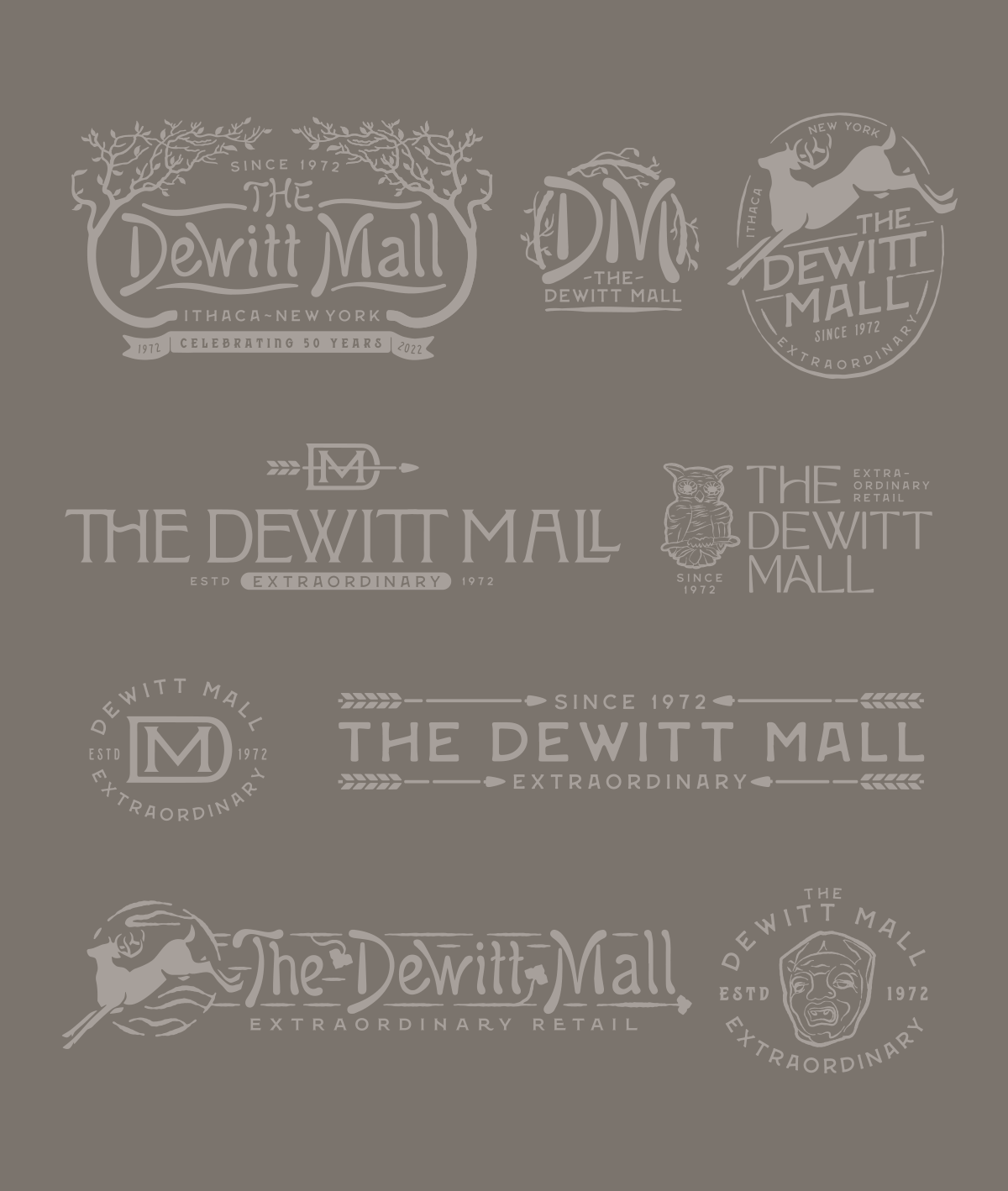
BWM developed a full logo exploration in multiple directions, each drawing from different aspects of the building’s design language, before landing on the selected mark shown in the upper-left corner of this page. The chosen logo draws on the Art Nouveau aesthetic that lives within the building: the flowing, organic lines, the decorative specificity, and the typography that feels rooted in a particular moment in design history while remaining legible and contemporary.
The exploration process itself is part of the story. A logo for a building of this complexity cannot be arrived at quickly or by shortcut. It requires immersion in the source material, multiple interpretations, and the discipline to keep pushing until the right answer emerges — not just a mark that looks good, but one that is genuinely true to what it represents.
WHERE IT STANDS
The new logo is complete, approved, and ready. The DeWitt Mall has yet to formally deploy it, which means what’s shown here is a brand identity waiting in the wings for a building that fully deserves it. When it launches, the DeWitt Mall will have a visual identity that, for the first time in its history, reflects the depth, the craft, and the singular character of what it actually is: a living piece of Ithaca that someone once cared enough to save, and that a community has been building inside ever since.