
The growth strategy everyone’s sleeping on while they argue about AI.
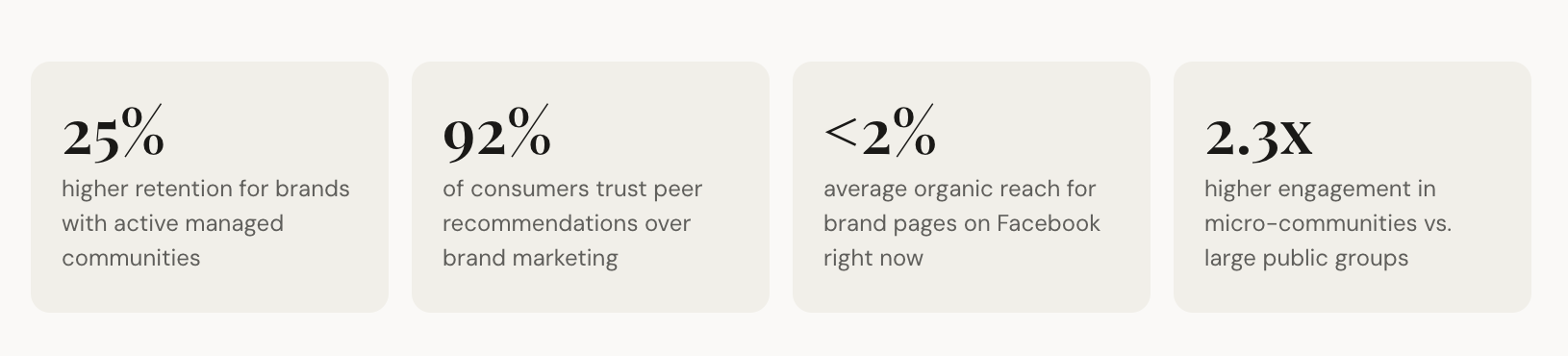
Organic reach on social media is almost dead. Facebook brand pages average below 2% reach. Instagram isn’t far behind. And ad costs keep climbing. Yet most agencies are so deep in AI conversations that they’ve missed the quieter, more durable shift happening beneath it all: the brands winning right now are the ones whose customers talk to each other, not just to the brand. Here’s how to actually do that.
Foundation: Know the difference between an audience and a community
An audience receives your content. They scroll past it, maybe like it, then move on. The moment you stop posting, the relationship ends. There’s nothing holding it together.
A community is a group of people connected to each other through your brand. They talk, they share, they help each other. That connection doesn’t disappear when you go quiet for a week. And when they buy, they buy again. They refer friends. They defend you in comment sections.
.
An audience member buys once when a discount lands. A community member buys repeatedly, refers people, and shows up on their own.
Getting Started: Start with 20 people, not 20,000
Pick your most loyal customers. The regulars. The people who’ve already been telling their friends about you without being asked. Invite them into something smaller and more private: a WhatsApp group, a Close Friends list on Instagram, a simple email thread.
Give them something genuinely useful or exclusive. Ask real questions. Let them talk to each other. That’s it. The flywheel starts here, not when you hit some arbitrary follower count.
Content Strategy: Let your community create content, then organize it
User-generated content ranks well in search precisely because it reflects genuine experience. Your community members sharing their own stories, reviews, and tips is worth more than anything you can produce in-house, and it costs you almost nothing to cultivate.
Your job is to make it easy, make it visible, and make it part of the culture. A simple prompt, a dedicated hashtag, a regular “share your story” ask. Collect it. Amplify the best of it. That content becomes evergreen.
Local Brands: In-person still beats digital for community depth
For regional and local brands especially, nothing builds community faster than getting people physically in the same room. A tasting, a tour, a workshop, a pop-up. The connections formed there will sustain your digital presence for months.
Think of in-person events as community seeds. Online touchpoints keep those relationships growing between gatherings. Both have to work together.
For Agencies: Stop measuring community by follower count
Follower counts are a vanity metric for community health. What you actually want to track: how often do community members talk to each other (not just to you)? How many referrals are coming from existing customers? What’s your retention rate for engaged members versus everyone else?
These are slower-moving numbers. That’s the point. Paid media gives you fast spikes. Community gives you compounding returns that paid media never can. The timeline is 12 to 18 months before you see its full shape. Plan accordingly when presenting this strategy to clients.
Watch Out: Don’t treat the community like a broadcast channel
This is where most brands go wrong. They build a Facebook Group or a Slack channel, then use it to push announcements and promotions into. That’s not community. That’s just another audience with a different interface.
Real community requires genuine participation from the brand. Responding. Asking questions. Sharing things that are useful, not just promotional. If your community posts look indistinguishable from your ad copy, you’re doing it wrong.